

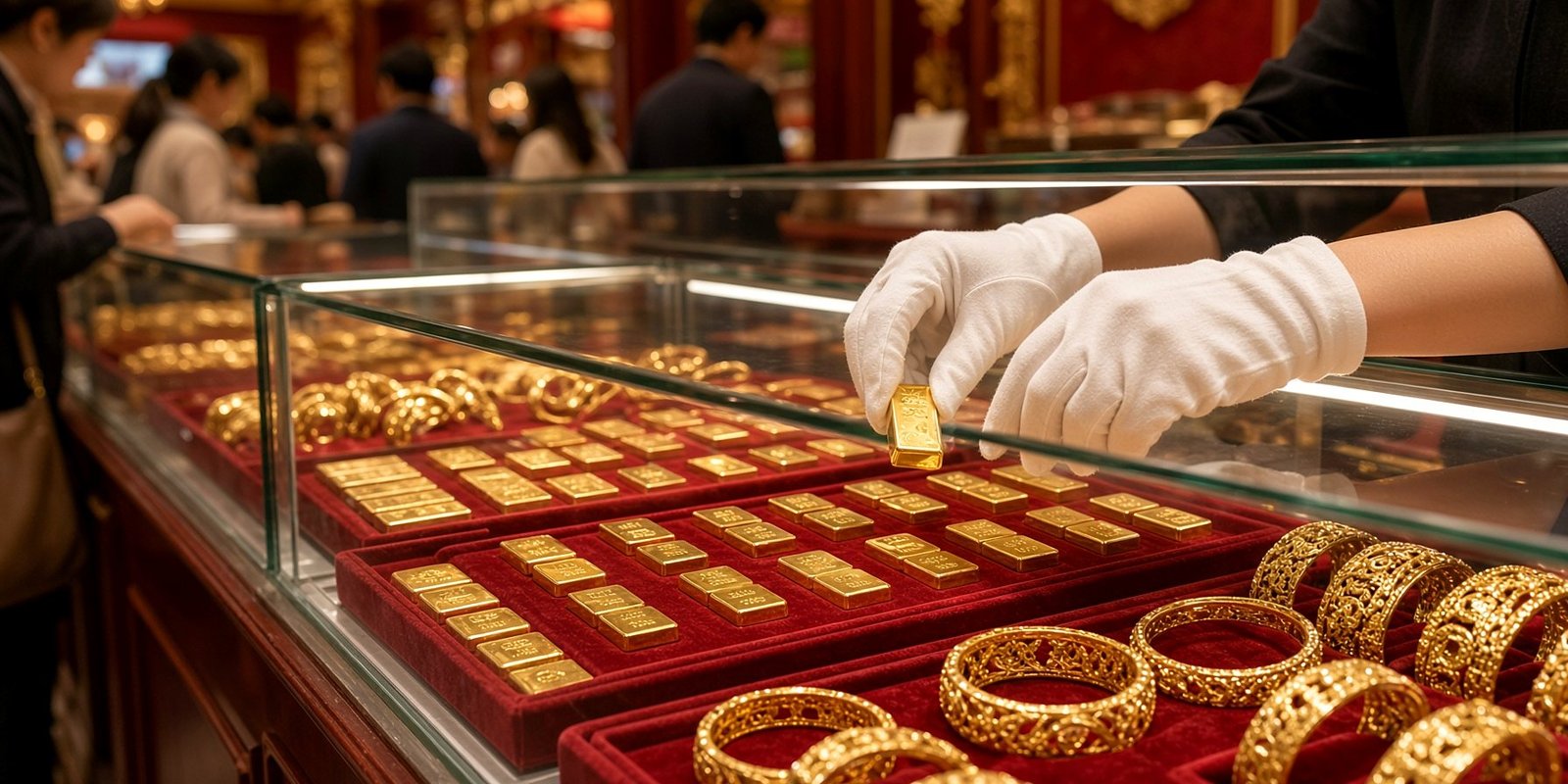
The China paper gold ban is real, and it lands after July 24, 2026. Five of the country’s biggest banks, ICBC, CCB, PSBC, Ping An and Guangfa, are ending retail paper gold trading for ordinary savers (INN, July 22, 2026). Beijing’s official line is consumer protection, shielding retail buyers from wild price swings. Plenty of market voices don’t buy that. They see something else: a deliberate move to strip out the speculative paper layer that sits on top of physical metal. Both readings can be partly true. We’ll weigh them.
What the China paper gold ban actually does
Paper gold accounts let a retail customer bet on the gold price through a bank without ever holding metal. No bar, no coin, just a balance that tracks the quote. After July 24, the five banks named above stop offering that product to new and existing retail clients. This isn’t a ban on owning gold. Chinese households can still buy bars, coins and jewelry, and they’ve been doing exactly that at a furious pace.
The scale of physical demand matters here. China imported 163 tonnes in May, a 26-month high, and 692 tonnes year-to-date through May, up 76% year on year (World Gold Council via Kitco, June 29, 2026). So the country is pulling in record metal while switching off a synthetic product. That contrast is the whole debate.
Paper versus physical, in plain terms
- Paper gold: a bank account entry that mirrors the price. Easy to trade, leveraged in aggregate, no delivery.
- Physical gold: a bar or coin you can hold. Slower to trade, no counterparty, no margin.
- What’s changing: the paper channel closes at retail. The physical channel stays wide open.
The consumer-protection case
Gold has been brutal in 2026. It hit an all-time high near $5,600 in January, then fell 14.1% in Q2, the worst gold quarter since 2013, dipping below $4,000 in June (Invesco via Kitco, July 8, 2026). Retail punters who piled into leveraged paper near the top got hurt. A regulator watching households chase a parabola and then eat a 25% drawdown has a straightforward reason to pull the product. That’s the benign story, and it fits the timing.
Even skeptics concede the official rationale is plausible on its face. Jay Martin of VRIC Media put it this way:
“[T]he official explanation is that this protects ordinary people from gold’s wild price swings. That explanation is convenient, but I don’t believe it.”
Jay Martin, CEO, VRIC Media (INN, July 22, 2026)
The de-paper-the-market case
Here’s where it gets interesting. The bearish-on-paper camp argues that synthetic gold, futures and unbacked accounts, lets large players suppress the price using leverage they’d never post in physical. Kill the paper, and price discovery shifts back toward metal that actually has to be sourced. Matthew Piepenburg of Von Greyerz didn’t hedge:
“China isn’t stupid… They know that we use massive amounts of leverage to force the boot to the neck of gold.”
Matthew Piepenburg, Partner, Von Greyerz (INN, July 22, 2026)
You don’t have to swallow the full suppression thesis to notice the direction of travel. China has also been overhauling its gold import and export rules in a way that reduces the PBoC’s oversight role in the flow of metal (Kitco, June 29, 2026). Two moves, same quarter. One trims the paper layer at retail, the other loosens the plumbing for physical. Read together, they look less like an accident and more like a preference for metal over promises.
Context helps here. Central bank appetite for gold sits at a record. In the World Gold Council’s 2026 survey, 89% of central banks expect global official gold holdings to rise over the next year, and a record 45% plan to add to their own reserves (WGC survey, June 16, 2026). A country whose official sector wants more metal, not more paper claims, would logically want its household channel pointed the same way. That’s the through-line connecting the retail rule change, the import surge and the plumbing overhaul.
Our snippet-ready take
The China paper gold ban stops five major banks from offering retail paper gold accounts after July 24, 2026. Beijing calls it consumer protection after gold’s 14% Q2 crash. Critics call it a push to shrink the speculative paper layer while record physical imports keep flowing. Both motives can hold at once.
Why this isn’t China cooling on gold
The easy misread is that Beijing is backing away from bullion. The import figures say the opposite. So does the physical bullion trade. Joshua Rotbart, whose firm deals in the real thing, drew the line clearly:
“Do not mistake this for China cooling on gold. What is being switched off is the speculative paper layer.”
Joshua Rotbart, Managing Partner, J. Rotbart & Co. (INN, July 22, 2026)
That framing squares the circle. A government can decide that its citizens should own gold the old-fashioned way, in a vault or a drawer, while deciding that leveraged paper bets on the price are a source of household risk it would rather not underwrite. The policy is anti-paper, not anti-gold.
- Bull read: less paper supply plus record physical demand tightens the real market and supports price over time.
- Bear read: a retail product closing in China changes little for a global market where COMEX and LBMA set the marginal price.
- Middle read: it’s a signal about Beijing’s preferences more than an immediate price catalyst.
What we’re watching next
The near-term price driver isn’t in Beijing. It’s the July 29 FOMC meeting under hawkish Fed Chair Kevin Warsh, with markets still pricing meaningful odds of a September hike. Gold was defending support around $4,000 to $4,021 in the week of the ban (Kitco AM Report, July 21, 2026). If Chinese physical imports stay near record levels through the summer while the paper channel narrows, the structural argument for a firmer floor gets harder to dismiss. Watch the monthly PBoC reserve announcements and China’s import data. Those numbers, not the rhetoric, will settle which reading was right.
Frequently asked questions
Does the China paper gold ban stop people from owning gold?
No. It ends retail paper gold accounts at five major banks after July 24, 2026. Physical bars, coins and jewelry remain available, and Chinese physical imports hit a 26-month high in May 2026.
Which banks are affected?
ICBC, CCB, PSBC, Ping An and Guangfa are named in the July 22, 2026 reporting. These are among China’s largest lenders, so the retail reach is significant.
Is this bullish or bearish for the gold price?
It’s ambiguous in the short run. Bulls argue that shrinking the paper layer tightens the physical market. Skeptics note a single retail product in China won’t move a global price set on COMEX and LBMA. The bigger 2026 driver remains Fed policy.
Why now?
Timing followed a rough stretch for gold, down 14.1% in Q2 2026, its worst quarter since 2013. Beijing frames the move as protecting retail buyers from that volatility. Critics see a deliberate reduction of speculative paper.
By the Commodities Unfiltered desk. Last updated July 2026.
This is market analysis, not investment advice.
Leave a Reply